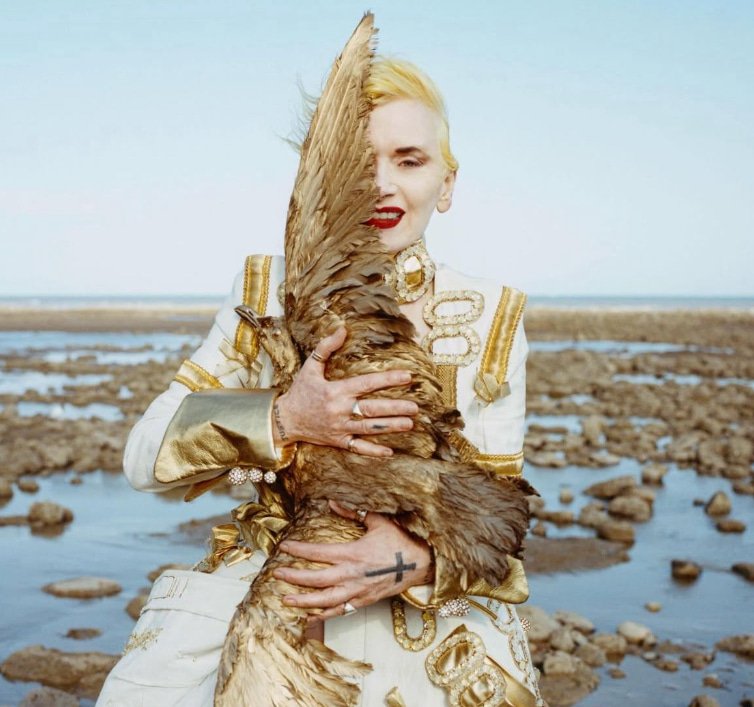
They never knew how to classify her. And that’s precisely why Pam Hogg mattered.
The Scottish designer, fashion icon and musician behind decades of stage-searing looks for rock’s most experimental women has died, her family confirming the news on Wednesday via Instagram. The caption touched all the souls of the fashion world and specially the underground artists: Pamela passed peacefully, her spirit defiant to the end, her legacy built to inspire, disrupt, and leak joy. A glorious life lived and loved. It was tender and feral, exactly the tonal collision Hogg projected in everything she touched.
To call her a “fashion designer” always felt too narrow, too polite. Hogg was couture only in the way punk is couture, attitude exploding in every seam. Born in Paisley, a textile town shaded by Glasgow’s industrial halo, she studied fine art and printed textiles at the Glasgow School of Art. She collected early honors like any avant-garde artist of her time, including the Newbury Medal of Distinction. Later, she earned a Master’s at London’s Royal College of Art. But institutions simply sharpened her, they never domesticated her.
Music entered Hogg before the runway did. In 1980, still in her 20s, she joined Rubbish, a band straddling punk abrasion and rhythmic prank-energy, opening for The Pogues. Nights later, you could spot her skulking outside Blitz nightclub with fellow degenerates of the “Blitz Kids,” the nucleus of ’80s London’s post-glam scene. The club enforced lunacy as dress code, so Hogg stitched her ticket mainly with Lycra designing looks outrageous enough to pass the door’s mythological bouncer test.
In 1981, she launched her first fashion collection through Hyper Hyper markets, selling at Hyper Hyper, then later opening a shop in London’s West End. Her collection names alone were manifesto poems: Wild Wild Women of the West, Best Dressed Chicken in Town. Humor was the key to her designs and the provocation to attire customers. At a time when British fashion needed permission to be bold, Hogg bypassed it, sealing the UK’s new reputation for unhinged textile play. Lycra catsuits turned into synthetic second skin, psychedelic colorways detonated like rave-era migraines worth keeping.
Her double life never became a fallback, it became fusion. She performed with the acid-house collective The Garden of Eden, toured with industrial noise titans Pigface and Pigface, and in 1993 formed the band Doll five days before opening for Debbie Harry. She was quick-wired for collaboration, allergic to hesitation, dependent on urgency.
Cinema, too, felt her static spark. She created Accelerator, a fashion film starring Anita Pallenberg and Bobby Gillespie, compressing style, sound, and psycho-glam momentum into a short-circuit audiovisual sermon. By 2009, she returned to the runway fully formed, debuting at Paris Fashion Week in 2012, where the industry discovered what London had long feared: not a designer reshaping high fashion, but its glorious opposite. Her later work weaponized PVC, leather, and tulle like devotional metal, blending BDSM subculture with hyper-feminine curves. One recycled materials apron dress from the 2014 Future Past collection read: “The soils of war.” It was industrial poetry.
She permanently fused fashion and music designing for Siouxsie Sioux’s 2004 world tour, Sioux would continue to wear her looks like battle regalia for years. Her roster of muses was the unofficial census of pop’s fearless blondes and not-always-blondes: Kylie Minogue, Lady Gaga, Rihanna, Kate Moss, Naomi Campbell.
Age was her only non-disclosure; identity was her shouting medium. Yellow hair a permanent filament of dissent. When asked about her place in fashion in 2014, she answered by rejecting the question entirely: “I create because I can’t not.” Exactly. Creation not as career but chemical dependency.
There is underground, there is mainstream, and then there was Pam Hogg, rubber-soled, uncompromising, and forever too loud for any single category. The wardrobe aftershock of a creator who made the world more improper, more elastic, more itself.