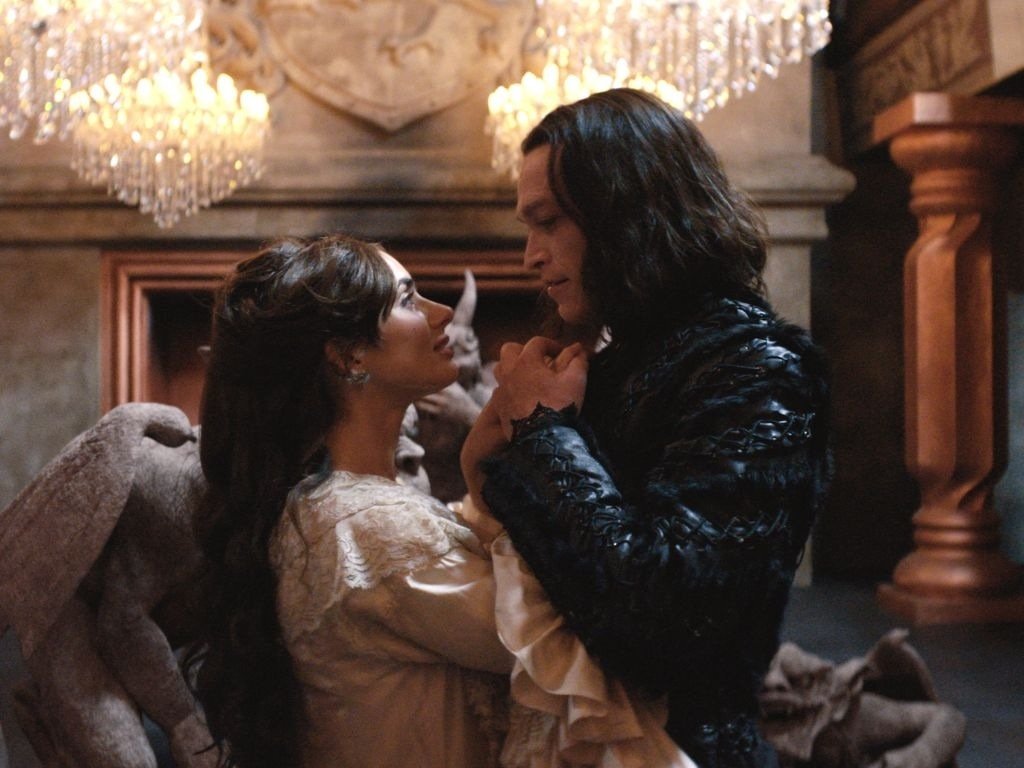
From Bela Lugosi to the controversial film of Francis Ford Coppola to the recent Nosferatu production, Dracula of Luc Besson launches a new blow of fresh air to astonish spectators and marks his return to the fantasy genre after The Fifth Element. With a budget of 49.5 million dollars, filmed between Finland and Darkmatter’s studios in Paris, where they created a 4,000-square-meter space to bring to life ancient Transylvania, his film promises a radical change.
The story begins in the 15th century when Vlad II of Romania, a.k.a. Count Dracula, starts a fight against the Muslims in the name of God, where unfortunately his precious princess Elisabeta is murdered. After the tragic event, knowing that pure souls can reincarnate, he decides to launch himself into a furtive chase to get her back no matter the cost, even if 400 years go by. Regardless of the fact that the story begins in Transylvania, a sudden departure from the original novel places the most important second décor in a festive Paris of La Belle Époque.
Another director taking yet again inspiration from Bram Stoker’s novel, but, what makes this film different from the others? A new element comes into the equation, and that is the construction of the character Dracula as a tragic and passionate persona whose main quest is led by pure love. His pursuit of his beloved Elisabeta through the centuries plays a different view of the known Count. His motivations and his personality are more complex than in his other versions; he has depth, and by placing his ideas of the world revolving around the chase of eternal love, Besson creates a character that aspires for more—he becomes more human than the other Draculas.
The main lead takes form in the hands of Caleb Landry Jones, the skillful American singer and actor, but he is not alone. In the supporting cast, we can find the talented Christoph Waltz, Matilda De Angelis, and Zoë Bleu. Waltz performs in the skin of the devout priest who brings enigmatic knowledge of the supernatural to the doctors of old Paris, adding ethical and philosophical questions of human nature and religion to the mix. Nonetheless, his figure in the film can evoke the famous “grey character” definition, since he removes his archetype of villain to represent a more tender and comprehensive version of the religious figure that appears in other versions of the film.
Besson revealed he committed himself to create the movie tailoring it to the measures of Caleb Landry Jones, since the actor resembled a perfect Dracula before the director’s eyes. Jones and Besson had previously worked together in Dogman, where the director referred to him as “the best actor of his generation,” and since then they had agreed to work together on a new production.
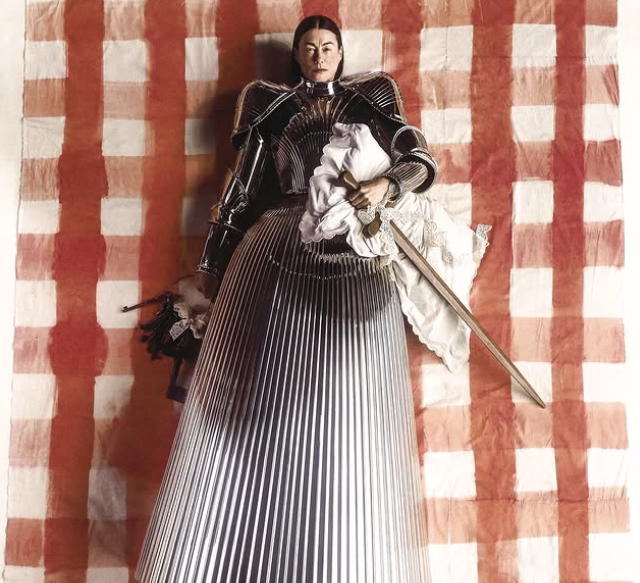
The costume department plays a major role in creating the perfect atmosphere in different historical settings, bringing a dark, romantic terror of Transylvania yet a candid Paris to the scheme. The contrast between the medieval ensembles of the 15th century and their duality with the tasteful, elegant Parisian Edwardian fashion from La Belle Époque and its peak luxury accentuates the temporal duality of the plot.
Besson defies the original tale but keeps the core. He dares to approach the classical story with taste, yet aiming for a slight controversy with the construction of his characters and locations, but nonetheless leaving his signature on the film. There are always more layers to peel in stories than what meets the eye, and rich characters like Luc Besson’s Count Dracula leave the audience full yet yearning for more.