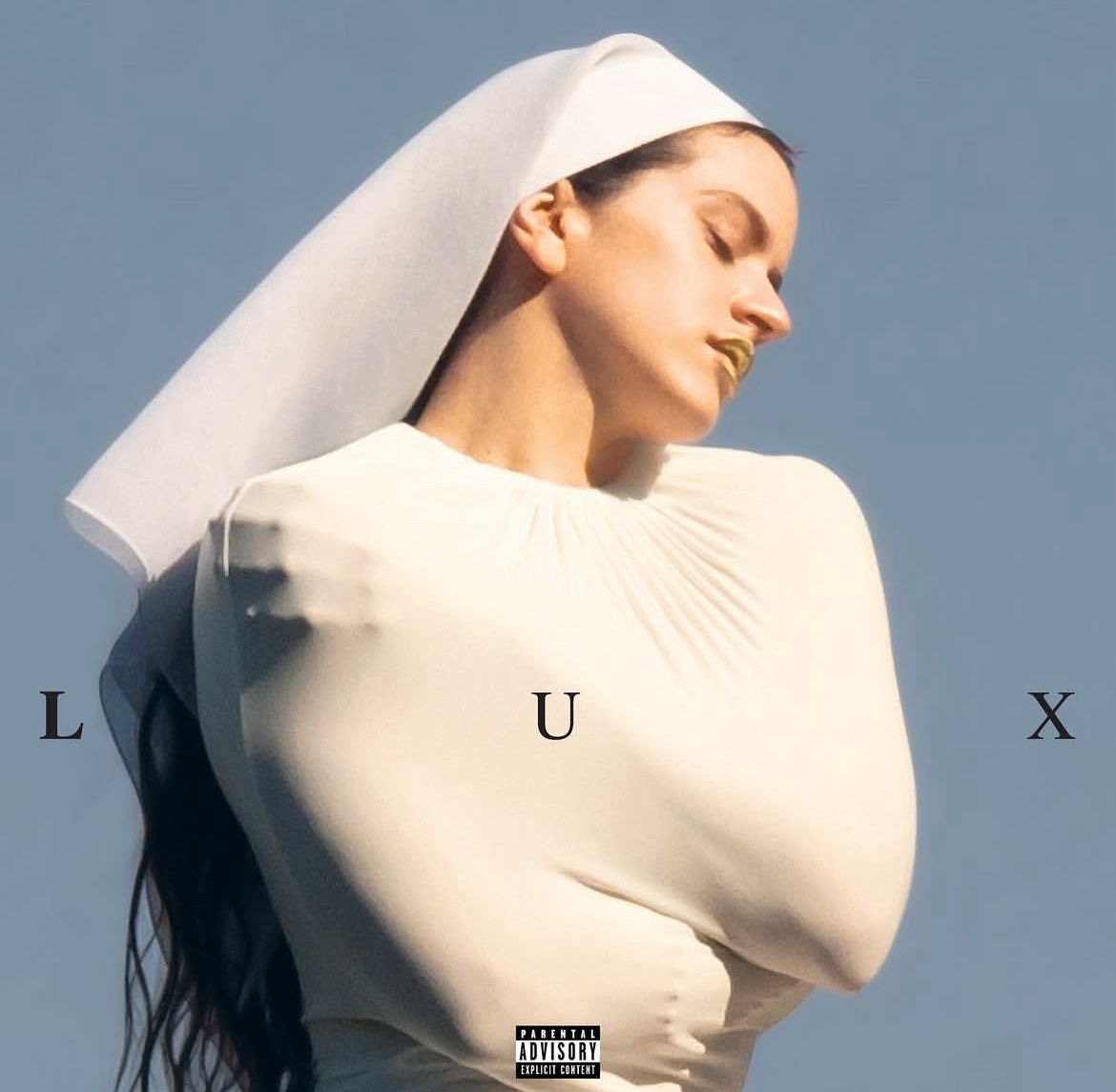
Rosalía has always treated pop like a collision experiment, but with Lux, her fourth studio album, she engineers the impact at a planetary scale. After three years of near monastic retreat the Catalan icon ends Fashion Month level turbulence with a record that feels less like a release and more like a rite.
Lux clocks in at a full hour and unfolds in four distinct movements, a symphonic architecture housing 18 songs and a harmonic worldview articulated in 13 languages. It’s radical not because it flaunts multilingualism, but because it weaponizes it. Spanish, Catalan, English, French, Arabic, Mandarin, a constellation that works perfectly like a clock. Rosalía isn’t translating herself for the world, she is collapsing cultural boundaries until they blur into irrelevance. If her earlier work hybridized flamenco with hyperpop, Lux sutures pop with the sacred, actively courting spiritual confrontation, feminine mysticism, and the universal loop of heartbreak and transcendence.
The album’s first movement, Sexo, Violencia y Llantas, opens loud enough to rattle stained glass, but the aggression is misdirection. Beneath its rumbling chassis lies piano clarity. In Reliquia, she excavates loss through city-coded confessions: “Seré tu reliquia,” “No soy una santa, pero estoy blessed,” “El cielo nació en Buenos Aires,” “Lost my time in L.A.” The specificity feels like a diary decoded for stadium acoustics, tracing emotional exile, particularly the L.A. years tied to her publicized and now post-mortemed bond with Rauw Alejandro.
By the second movement, the pulse tightens. Berghain, a hinge built from the saint and the nightclub, evinces the album’s thesis: duality is destination. Sweetness, fragmentation, and pop mythology converge, nodding to collaborator Björk, whose own myth began in The Sugarcubes. This isn’t cameo-baiting, it’s lineage acknowledgment, pop DNA held up to the light.
From there, Rosalía walks through her own chrysalis. La Perla is the record’s emotional guillotine, not named, but unmistakably felt. “Campo de minas para mi sensibilidad,” she sings, mapping a break that feels personal and spectral. De Madrugá intensifies the purge: chains, stars, entitlement to catharsis. And then, a miracle: the third movement begins.
Light breaks open through percussion. Dios es un stalker kicks the confessional into dance, acceptance replacing autopsy. In Focu ’ranni, the rebuke becomes oath, self-owned and irreversible: “Nunca seré tu mitad,” “Seré mía,” “Mi corazón nunca tuvo tus iniciales.” The calm is not surrender, it is border control.
The final movement reframes power and adornment. Novia robot reworks feminism into futurist scripture, partnered by liberation mantras that sound like spells reversing history: “Te liberé, me liberé,” and the sanctified vanity-as-prayer, “Me pongo guapa para Dios.” Beauty here is not gaze currency, it is transcendental armor.
Musically, Lux was captured alongside the London Symphony Orchestra, conducted by Daniel Bjarnason, and features a chorus of female vocal forces, Björk, Carminho, Estrella Morente, Silvia Pérez Cruz, and others. The visual announcement hit Times Square in white veil silhouette and bright neon Lux, a teaser of the album’s new doctrine: pop is mortal, myth is not.
Rosalía’s sonic renaissance, produced with Noah Goldstein and Dylan Wiggins, is audacious not for rejecting her past, but for canonizing it. She ascends by disintegrating, becoming dust, stellar, sacred, and finally her own.